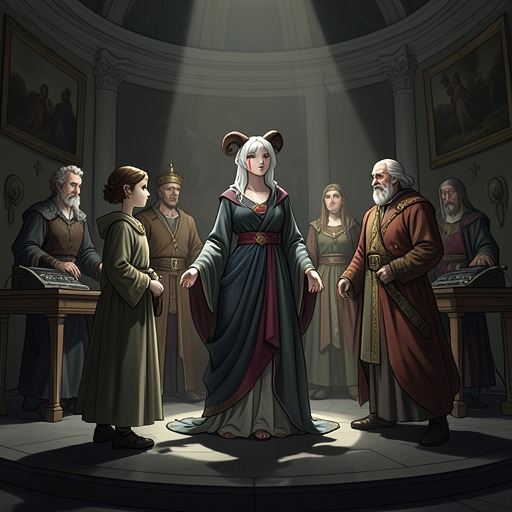
Vivi · Vivisari
New Life as a Max Level ArchmageVivi / Vivisari’s decisive significance lies in the contradiction between how the world remembers her and how she moves through it in the present. Once associated with the Party of Heroes and the victory that ended the Cataclysms, she returns to a society that has turned her image into history, devotion, and public spectacle. Yet the living figure is neither a distant saint nor a ceremonial relic. She is an active mage who tests forbidden or obscure knowledge, equips Saffra with extraordinary resources, maintains several public identities, and treats dangers capable of terrifying entire nations as problems to be investigated and managed.
Legendary Identity and Return
Vivi’s place in public memory is established through the religious culture of Prismarche. Prismarche Temple is built of polished white stone, with tall stained-glass windows showing saints and heroes; among the prominently displayed figures is an image of Vivi and her Party of Heroes. The arrangement turns her past into something almost sacred before she has even re-entered the city’s social world. Her own reaction is markedly less reverent: she is dismayed to find herself represented in the temple and hesitates before approaching a priest, suggesting a sharp distance between the public legend and the private person who must now navigate its consequences.
The priest explains that the Party of Heroes triumphed over the seventh and final Cataclysm nearly a century earlier, though all but the Sorceress perished in the struggle. That account gives Vivi’s return an inherently unstable historical meaning. The world credits the party with salvation, but the survival of the Sorceress has been obscured or misunderstood, while a hundred years of technological and civic development have transformed the setting to which she returns. Vivi therefore reappears not merely after an absence, but after an entire historical interval in which her identity has been converted into inherited memory.
Her return coincides with Prismarche’s Peace Day Festival, held on the one-hundred-year anniversary of freedom from the Cataclysms. The citizens celebrate with enormous enthusiasm, even though the younger generation has not personally witnessed the horrors once inflicted by the Flesh-Weaver’s Rampant Genesis, the Reaper of the Lost Harvest’s Crimson Blight, or the Ashen Hierophant’s Great Conflagrations. Vivi understands both sides of the occasion: the populace reveres the Party of Heroes because it saved the world from incomprehensible terrors, while she recognizes how easily lived catastrophe becomes a commemorated pageant once its survivors are gone.
Power, Judgment, and the Threat of Another Cataclysm
Vivi’s power has increased dramatically during her time away. The ease with which she defeats the Greater Voidbeast leads her to wonder whether she has reached, or surpassed, the apparent summit once occupied by the greatest Cataclysm Monarchs. The scale of that achievement alters the political and symbolic meaning of everything she does. She is no longer simply a powerful adventurer returning to a familiar world; she has become a force whose casual intervention can change how witnesses understand reality itself.
That transformation is made explicit when she tears a Cataclysm apart with such ease that observers are unlikely to identify the figure responsible as the Sorceress. They would instead assume that a god had appeared, or that the heavens themselves had descended to intervene in a battle of otherworldly origin. The irony is central to Vivi’s characterization: even a legend as famous as Vivisari is inadequate to explain what she has become. Her past identity remains useful, but her present capabilities exceed the conceptual frame through which the world knows her.
Vivi’s conversation with Master Aeris places this power against a continuing horizon of dread. She argues that the Dragon King could descend from the Sky-Pillar Range and raze the mortal lands, that an unknown horror might awaken from a millennium-old crypt, and that another Shattered Oracle could emerge from a single overambitious glimpse. Her conclusion is that there is always an Eighth Cataclysm on the horizon, although there is no promise of one at that instant. The statement does not deny danger; it distinguishes immediate evidence from permanent possibility. Aeris finds the distinction reassuring, while Tatiana does not, revealing Vivi’s more measured relationship to threats that others experience as existential terror.
Research, Aliases, and Magical Method
Vivi’s objectives are not limited to combat. Her curiosity drives her toward obscure magical branches, especially the dimensional anomaly above Prismarche. When confronted by Osmian, she refuses to make her personal name or reputation the center of the exchange and asks to be called Nysari or Vivi. Rather than seeking the ordinary reward for surviving his trials, she proposes a conversation about an esoteric field of magic. The detour becomes worthwhile because it may yield information about the anomaly, even though she doubts Osmian can assist her as Master Aeris can.
The name Nysari is not a casual disguise. In public, Vivi instructs Saffra to call her Nysari because that persona is intended to obtain access to restricted sections of the Institute’s Library. She possesses a Keresi signet ring and a letter of credence, resources that support the identity’s institutional legitimacy. The arrangement shows how deliberately she separates private identity, political presentation, and scholarly access. Her multiple personas are practical instruments rather than evidence of confusion: each one allows her to move through a different layer of the world without exposing the full force of her history.
Vivi also gains permission from Osmian’s ghost to establish a warp anchor in his office. This gives her a direct means of returning to him for consultation and, because Osmian’s Door can manifest in nearly any location, provides convenient access to the Institute and its Library. After the encounter, she and Saffra resume their research, collecting general reference books, copying them, and storing the copies. Vivi’s method combines overwhelming mobility with patient accumulation: she can teleport across the city and reach distant hunting grounds, yet she still values books, archives, controlled experiments, and the possibility of a useful conversation.
Her experimental approach appears again when she produces the codex bearing a silver symbol of a black sun and tells Saffra that she needs to test how it works. Vivi immediately prevents Saffra from using Inspect on the object; the attempted examination fails and displays an inspection-failure message. The moment establishes both the codex’s resistance to ordinary appraisal and Vivi’s control over the conditions of discovery. She does not simply possess mysterious artifacts; she designs procedures for learning what they can do while limiting premature access to their properties.
Mentorship and Material Protection
Vivi’s relationship with Saffra is expressed through instruction, equipment, and carefully calibrated protection. She gives Saffra armor that she made herself because ordinary market quality would not have been acceptable. Compared with the gift that follows, however, the armor is almost incidental. Vivi produces a brilliant gold-and-orange feather that constantly sheds motes of fire, melting snow within fifty feet until Vivi suppresses its effect, and offers it to Saffra for protection. The contrast between the handmade armor and the far more exceptional feather makes the gift feel less like ordinary equipment than an acknowledgement of the danger Saffra may face.
Vivi’s generosity is not limited to singular relics. After Saffra successfully masters Scorchlance, Vivi gives her scrolls containing defensive magics of the sixteenth tier and higher, then directs her toward another spell to pursue. She explains that coaching in spell design and mana exercises cannot cover every part of Saffra’s education, and that the Institute’s Library can fill the gap. The mentorship therefore has a defined intellectual structure: Vivi provides advanced practical training, recognizes the limits of her own instruction, and builds a route through which Saffra can continue learning independently.
Vivi is also willing to permit Saffra’s mistakes when the cost is manageable. During a leveling session, Saffra vaporizes a significant quantity of crafting materials while using a supercharged Scorchlance. Vivi stops the girl’s panicked apologies and explains that she could have extinguished the spell herself but deliberately allowed it. The decision reframes failure as part of controlled development. Because Vivi can replace lost materials or obtain resources from higher-rank hunting grounds, she can give Saffra room to practice without allowing a failed experiment to become a catastrophe.
Relationships, Authority, and Narrative Role
Vivi’s authority is most visible in her interactions with powerful or arrogant figures. Osmian’s trial construct presents itself as an archmage and dismisses those far beneath its level, including Saffra. Vivi tolerates skepticism directed at herself but reacts differently when the contempt approaches Saffra. Her restraint is conditional rather than passive: she lets the insult stand only while deciding whether it has crossed the boundary that would demand action. In this way, her strength functions as protective authority, not merely personal superiority.
Her interactions with Master Aeris reveal another dimension of that authority. Aeris recognizes her presence as a shock and is visibly relieved to find her alive and healthy after so many years. Vivi, however, does not exploit his reverence or convert the reunion into a ceremony. She answers the larger fear with a distinction between possible future disaster and immediate fact, then returns to practical concerns. Her manner repeatedly pulls the story away from worship and toward action: investigate, test, equip, consult, and move on.
At the end of the supplied trajectory, Vivi orders Rafael to find out what he can learn and then teleports away without waiting for a response. The gesture is characteristic. She delegates intelligence work, makes decisions quickly, and refuses to remain in place merely because others are still processing what they have witnessed. Her departure leaves Rafael to regain his composure and continue his mission, while Vivi’s overwhelming display of force remains to be interpreted by the world around her.
Vivi thus occupies several narrative roles at once. She is the returned hero whose image survives in temples and festivals, the concealed identity moving under the name Nysari Keresi, the mentor who expands Saffra’s capabilities, and the investigator who treats the dimensional anomaly as a concrete magical problem rather than a superstition. Her most important contrast is between the sacred image others project onto her and the controlled, curious, sometimes bored practitioner who continues working. The world may call her a legend or mistake her for a god, but Vivi’s own significance lies in what she does after the legend has ended: she keeps testing the limits of power, knowledge, and survival while preparing for the next disaster that may—or may not—arrive.